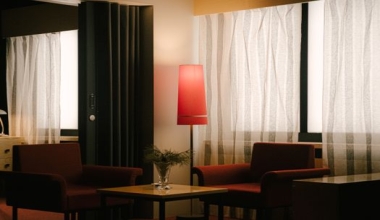
When it comes to controlling noise in your home or office, curtains play a significant role. But not all curtains are created equal. Standard curtains are primarily decorative, while acoustic curtains are engineered to dampen sound. This comprehensive guide will help you understand the differences, benefits, and best use cases for each, so you can make an informed decision.

What Are Acoustic Curtains?
Acoustic curtains, also known as soundproof curtains or noise-reducing drapes, are specially designed window treatments made from dense, multilayered fabrics. They are engineered to absorb sound waves, reduce echo, and block external noise. Unlike standard curtains, they often incorporate mass-loaded vinyl (MLV) or multiple layers of thick material to achieve a high Sound Transmission Class (STC) rating.
How Acoustic Curtains Work
Sound travels in waves. When these waves hit a surface, they can be reflected, absorbed, or transmitted. Acoustic curtains use dense materials to absorb sound energy, converting it into heat energy. The layers and thickness create a barrier that reduces the amount of sound passing through. They are most effective for mid-to-high frequency sounds like traffic, conversations, or office noise.
___PROTECTED_1___
What Are Standard Curtains?
Standard curtains are primarily decorative elements. They come in various fabrics like cotton, polyester, or linen and are designed to enhance aesthetics, provide light control, and offer a degree of privacy. While they can slightly dampen sound due to their mass, they have no acoustic engineering. Their primary purpose is visual appeal and basic light filtration.
Common Standard Curtain Materials
- Cotton: Lightweight, breathable, but offers minimal sound absorption.
- Polyester: Durable, wrinkle-resistant, but lacks density for noise control.
- Linen: Elegant drape, but thin and transparent, providing negligible sound reduction.
- Velvet: Heavier and denser, offering better sound absorption than lighter fabrics.
___PROTECTED_2___
Key Differences: Acoustic vs Standard Curtains
The primary difference lies in their purpose and construction. Below is a comparison of critical factors.
| Factor | Acoustic Curtains | Standard Curtains |
|---|---|---|
| Sound Absorption | High STC rating (up to 25-40 dB reduction) | Low to none (0-5 dB reduction) |
| Material Density | Multiple layers, often with mass-loaded vinyl | Single layer, lightweight fabrics |
| Weight | Heavy (up to 10 lbs per panel) | Light to medium (1-4 lbs per panel) |
| Installation | Requires strong rods, floor-to-ceiling coverage, sealed edges | Simple, any standard rod or track |
| Cost | High ($50-$200+ per panel) | Low to moderate ($10-$60 per panel) |
| Light Blocking | Usually 100% blackout (lined) | Varies from sheer to room-darkening |
| Aesthetic Options | Limited colors and styles (often utilitarian) | Wide variety of patterns, colors, and textures |
Performance Comparison: Sound Reduction
Acoustic curtains are specifically tested for sound reduction. They typically have an STC rating between 20 and 40. Standard curtains have no such rating. In real-world terms, acoustic curtains can reduce noise levels by up to 50% depending on frequency and installation. However, they are not a complete substitute for structural soundproofing like double-glazed windows or mass-loaded walls.
Practical Tips for Maximizing Sound Reduction
- Use floor-to-ceiling and wall-to-wall coverage to prevent sound leaks around edges.
- Choose acoustic curtains with a minimum of 3 layers or added MLV core.
- Pair with a ceiling-mounted track to create an air seal.
- For standard curtains, choose heavyweight velvet or lined blackout curtains for better but limited effect.
- Combine curtains with other sound-absorbing elements like rugs and acoustic panels.
Cost Considerations
Acoustic curtains are significantly more expensive due to specialized materials and construction. A single panel can cost $80–$200, and you may need multiple panels for a large window. Standard curtains are budget-friendly, ranging from $10 to $60 per panel. However, if noise reduction is critical, the investment in acoustic curtains is worthwhile. For budget-conscious shoppers, layering standard blackout curtains with heavier fabric can offer marginal improvement at a lower cost.
Installation Requirements
Proper installation is crucial for acoustic curtains to perform. They require heavy-duty rods or ceiling tracks that can support their weight. For optimum performance, the curtains should extend beyond the window frame and touch the floor. Gaps between panels must be minimized—use overlapping panels or magnetic closures. Standard curtains are easy to install on any rod, but gaps will reduce any potential sound-dampening effect.
Maintenance and Care
Acoustic curtains are often dry-clean only due to their dense layers. Vacuuming with a brush attachment can help remove dust. Standard curtains are typically machine-washable, making them easier to maintain. Consider your lifestyle and willingness to care for heavy drapes when choosing.
Which One Should You Choose?
Your choice depends on your primary goal:
- Choose acoustic curtains if: You work from home and need to reduce traffic noise, live in a noisy apartment, or want to improve acoustics in a home theater or recording space.
- Choose standard curtains if: Aesthetics and budget are your main concerns, noise isn't an issue, or the room is already well-soundproofed (e.g., double-glazed windows).
Hybrid Approach: Combining Both
For best results, consider using acoustic curtains as a functional layer and placing sheer or decorative standard curtains on top. This gives you the noise reduction and the visual appeal without compromise.
Conclusion
Acoustic curtains are a specialized solution for noise problems, offering measurable sound reduction at a higher cost and with more significant installation demands. Standard curtains are versatile, affordable, and excellent for decoration, but they lack soundproofing capabilities. Evaluate your needs, budget, and willingness to handle heavy fabrics to make the right choice. For serious noise reduction, acoustic curtains are the clear winner; for simple style, standard curtains suffice.